


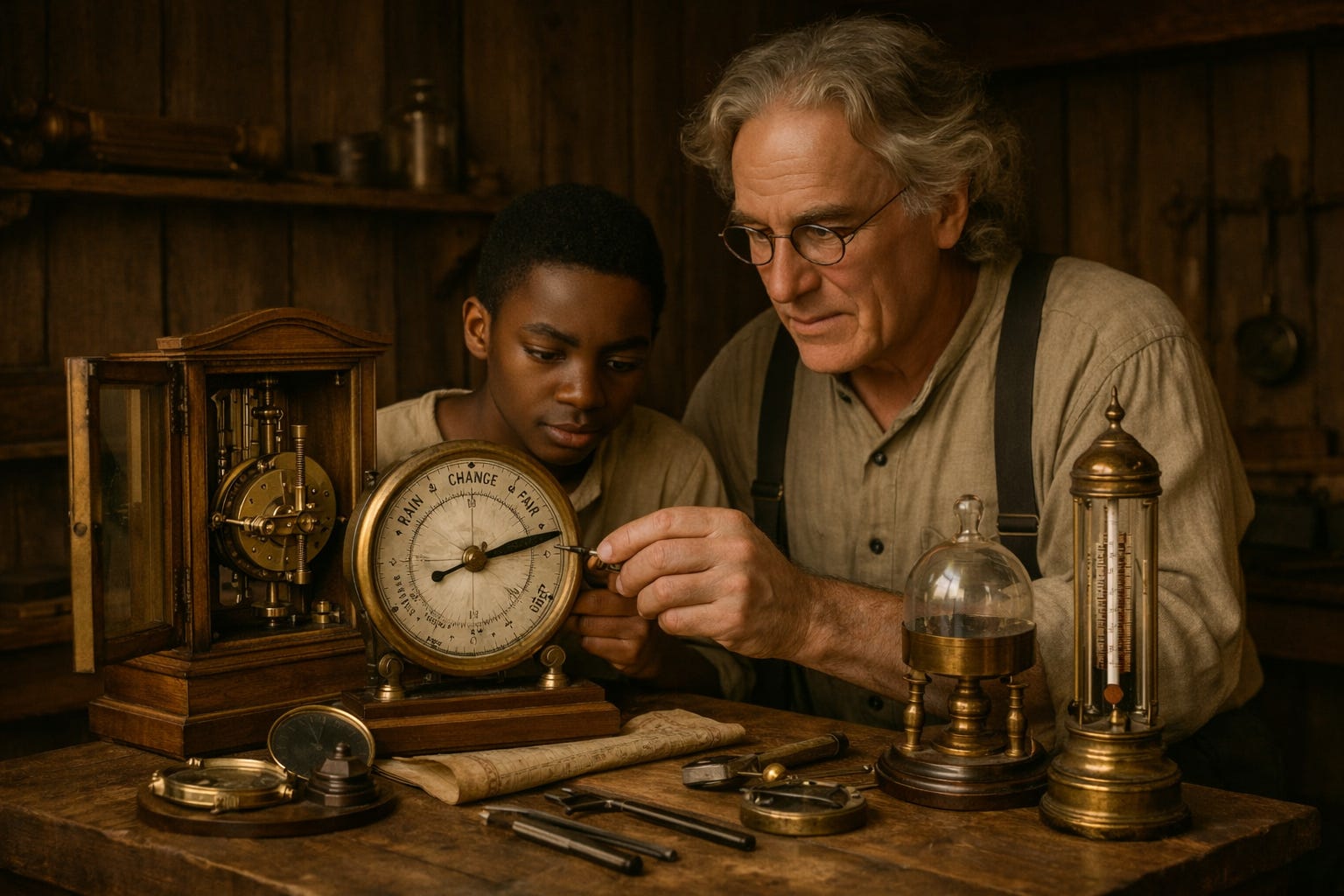
ENTRY - Concerning a Visitor from Monticello
It was a Wednesday, late in the forenoon, when the gentleman from Mr. Jefferson’s estate arrived, tricorn hat pulled low over his eyes. He did not introduce himself as a politician, even a retired one, nor did he bear any of the usual airs of one accustomed to being fawned over. He came as a student of nature, of time, of light, of air. A fellow pursuer of order in the midst of God’s creation.
The man bore a letter with Mr. Jefferson’s own hand. I recognized the script at once; it was the same as I had seen some years prior, when a parcel of French brass arrived with a polite inquiry as to whether I might repair a broken barograph once used at the College of William and Mary. This time, the request was more ambitious.
Mr. Jefferson wished to establish a complete weather station on the grounds of Monticello, “to track the invisible movements of the heavens,” as the letter put it. He asked for my assistance in building several instruments: a precision barometer, a dry and wet bulb hygrometer, a wind vane of durable construction, a large ship’s chronometer, and a rain gauge “of artful construction”, to be fixed near his garden walk.
Ezra had been at his workbench, sorting fine chain links for a longcase regulator we are assembling for the seminary in Emmittsburg. Upon hearing the visitor mention Monticello, he began a shanty about Mr. Jefferson’s famous collections.
Monticello’s up real high,
Touchin’ near the mountain sky.
Mister Jefferson’s got some stuff—
Clocks and bugs and bones and fluff.
Big ol’ teeth from some lost beast,
Draws the stars and writes the East.
Keeps his books in secret rows,
Even has a weatherglass that knows.
I’d bring him chains all polished neat,
Build a clock that skips no beat.
Bet his house just hums at night
Tickin’ soft and glowin’ light.
The gentleman from Virginia, observing Ezra with quiet amusement, asked if the boy assisted in the shop. “He does more than assist,” I replied. “The lad has an eye for balance and rhythm uncommon in one so young. He listens, watches, and remembers, like a movement wound tight and true.”
At this, Pascal leapt up from his sleeping nook and strutted across the bench as if summoned to verify the claim. The visitor laughed aloud, then reached to scratch behind the cat’s ear. “Professional mouser?” he said.
I responded truthfully. “Hobbyist.”
We spent much of the afternoon reviewing sketches Mr. Jefferson had provided, annotated with observations in both English and French. Some portions I found wanting in mechanical precision, his mind leans more toward architecture than gears, but his vision was sound. A garden, open to the sky, where the temperature, wind, and pressure might be recorded each day at dawn and dusk.
When I explained to Ezra the purpose of each instrument, he began humming a new rhythm under his breath, tapping the tempo of raindrops on the counterweight shelf. I suspect a new shanty is forming, one of weather and wind, of clouds that speak in barometric sighs.
As our guest departed, he left behind a small wooden case with polished fittings. “A token of esteem,” he said. Inside was a rare French escapement wheel, clearly salvaged from a damaged marine chronometer. I shall keep it for Ezra’s future projects.
This commission shall take three months at least, perhaps four, but I welcome it. Not for the prestige, nor for the coin, but because it is good work. Honest work. Work that marks time not in profit, but in presence and in attention.
That, I think, is what the old man in Monticello still seeks. A way to bear witness to each passing moment.
MV
ENTRY - A Watch for a Shepard
This morning, a man came by with a letter bearing the seal of the Archdiocese of Baltimore. He was soft spoken and weathered like a man who knows long days on horseback. A thin layer of dust on his cassock testified to this assumption.
His visit, however, was not one of crisis or confession, but placed the letter in my hands and asked me to break the seal and read it. Archbishop John Carroll requires a pocket watch suitable for his station in the church and his humility in Christ. It carried the signature of Father James Bors, priest-secretary.
I asked, with due humility, whether it was to mark the hours of prayer. The messenger only smiled. “To ensure he does not miss them,” he said. “The archbishop knows of your philosophy of greatness in precision with humility in appearance.”
There was no extravagance in the commission, only quiet clarity. A second hand, for precision. A case of American silver, not imported gilt. The face shall bear no inscription, save a small engraving inside the lid: “There is always time for kindness.”
I find myself reverent before the task. To measure time for a man who has outlived a revolution, baptized generations, and now bears the spiritual weight of a young republic. It is no small thing. A man like that does not ask for time, he stewards it.
I have chosen a fine chain, subtle in its strength. Like the man, I think. No jeweled flourish, no imperial fanfare. Only the calm, deliberate movement of hands, tick by tick, marking the hours between hope and duty.
Ezra asked if the watch would chime. “No,” I told him. “Some men carry bells inside them.”
I began with the mainspring.
For a man like Archbishop Carroll, measured in speech and deliberate in duty, the tension must be just so. Too tight, and the mechanism snaps. Too loose, and the hour falls behind. There is theology in balance, though I do not say it aloud.
Ezra sorted the screws this morning without being asked. He has learned which brass pins I prefer and sets them in a neat row at the upper left of the bench. He hums sometimes while he works. Today it was something about “bells in the fog,” though I suspect he made it up.
Bells in the fog, but I can’t see the steeple,
Muffled and slow, like the steps of good people.
Time don’t shout when the mist rolls in,
It taps on the water with a whisper-thin skin.
Tick tock hush, the hands still go,
Even if the sky forgets to glow.
Turn the gear and wipe the glass,
If you can’t find the future, polish the past.
Bells in the fog, and the sound bends down,
Like it’s lookin’ for someone who won’t be found.
But I hear it fine with my workshop ear.
It’s not lost, it’s just quiet… and near.
He held the case steady while I set the jewel in place. His fingers are small enough to manage the lip of the casing with ease. When I asked if he could see the gears aligning, he nodded. “Looks like a church,” he said.
I did not ask what he meant. I only smiled and tightened the backplate.
When we engraved the inside lid. “There is always time for kindness.” He read it aloud once, then whispered, “For him?” I said yes. And Ezra, who rarely looks people in the eye, said very quietly, “Good.”
Later, he polished the glass so gently it shone without heat. He placed it in the velvet pouch and nodded, satisfied. “It’s a nice one,” he said. “Even the ticks are soft.”
He’s right. This watch does not command. It reminds.
MV
ENTRY - CELESTIAL REMEMBRANCE
This morning, I guided young Ezra up into the cupola of St. John’s College, where we have begun to assemble a modest platform for observing the heavens. The boy’s fingers fairly danced across the brass fittings, and though he speaks little, the turn of his head and the narrowing of his eyes told me he had already discerned the alignment we shall use for the transit mounts. That child’s mind is a rare instrument, silent, precise, and ceaselessly in motion.
Charles Carroll graciously donated what previously served as his and William Paca’s office. Both men of forward thinking minds, yet blurred to freedoms for all men, did set a more liberal course of education than one may have expected.
I confess, as we stood beneath the dome, my thoughts returned to a story I first heard during my years among Friends in Philadelphia: of one Benjamin Banneker , a free man of color born to a blacksmith and a herbalist mother near Gunpowder Falls in Baltimore County. It was said Benjamin once borrowed a pocket watch from a surveyor and returned it in perfect working order, after having taken its measurements, rendered them in charcoal on bark, and then carved and assembled a replica from cherrywood and hand-forged nails.
More astonishing still, he became known for nightly observations of the moon and planets. Without any formal schooling, he taught himself arithmetic and ephemerides, and constructed a crude quadrant using only a plumb line, a half-circle of wood, and a sighting rod of hammered tin. Word of his talents reached the gentlemen of the Philosophical Society, who, though hesitant, eventually purchased one of his handmade almanacs for examination. His predictions, they reported, were “remarkably near the mark.”
I think of Benjamin often when I see Ezra lost in numbers or charts, or when he begins a humming rhythm that he insists corresponds to the ticking of some distant clock. The boy has not yet found all the words to tell us who he is, but he knows. He knows. And like Benjamin Banneker, he may yet chart his own heavens, wooden tools and all.
Heave away, haul up high,
To the dome where the bright stars lie!
Nail the sky with a hammer of brass,
Set the moon in a looking glass!
Climb the beams where the bluebird sings,
Hang the night on copper strings!
Chart the course where the comets play,
Measure time till the break of day.
Swing the lens and the stars hold still,
Mark the hour on Zion’s hill!
Up in the cupola, sharp and wide,
We chase the sky on the evening tide.
“There is always time for kindness,” I have engraved the sentiment in many of my instruments. But today I think, too, there must also always be time for wonder, and engraved that as well.
MV
